Choosing the right barcode symbology
This is meant to be an accessible introduction to the different kinds of barcodes that can be used and some rules of thumb for picking the right one. This article probably isn’t for you if you’re planning a mass rollout, but I hope it’ll be a useful starting point. Similarly, if you’re generating a label or document that’s been standardised, the decision may already have been made for you.
Everyone gets QR codes
QR codes are the most famous 2D barcode, everyone has heard of a QR code and probably scanned many of them. They have a distinctive appearance, even when stylised. They’re supported by every modern smartphone without installing anything. If you want members of the public to scan it, QR codes should be your default choice. QR codes are likely to become even more popular over the next couple of years as GS1 Digital Link QR codes start to take over from classic 1D EAN barcodes in the shops.
The downside of QR codes is that they’re relatively bulky as 2D barcodes go and while they’re somewhat damage tolerant, it depends on where that damage is.
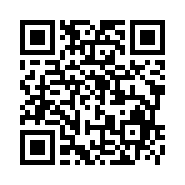
QR Code
But consider Data Matrix and Aztec
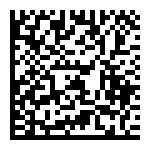
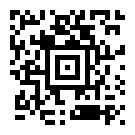
If you have more control over who/how you scan, Data Matrix and Aztec codes are well worth considering. They can be denser for typical payloads. Aztec codes are especially suited to environments where they might get damaged because the locator is in the middle, which is less exposed to edge wear than the corner locators on a QR code or the border locator on a Data Matrix symbol. Data Matrix is well established for part marking and its simple structure lends itself to many different physical marking methods like engraving, dot peening and laser. While not as well-known to the general public, Data Matrix barcodes are everywhere – just looking around my home I see them on the packaging for medicines, Amazon deliveries, letters from banks – and it’s even more popular in industrial and healthcare settings. Most Data Matrix symbols are square, but rectangular ones exist too – a rarer sight, though I’ve spotted a rectangular GS1 Data Matrix on H&M clothing tags. I see Aztec codes far less in the wild, I’ve spotted them on brewery kegs, rail tickets, airline boarding passes and the Tesco Clubcard.
The central locator on an Aztec code bears some similarity to the locators on QR codes, which may be a helpful affordance to users understanding how to scan it. This may not always be an advantage, because it may cause frustration if someone tries to scan an Aztec code with their phone’s built-in camera app and it doesn’t work. The iOS/Android camera app supports QR codes and my Samsung Android phone at least supports Data Matrix too. If the symbol is being scanned in your own app, this isn’t a problem, Google’s ML Kit and Apple’s VisionKit easily support any of these.
Data Matrix |
Aztec Code |
|---|---|
|
|
Anything else needs a good reason
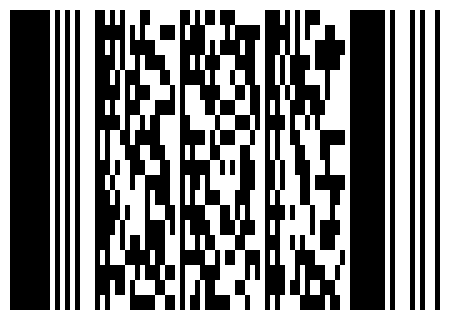
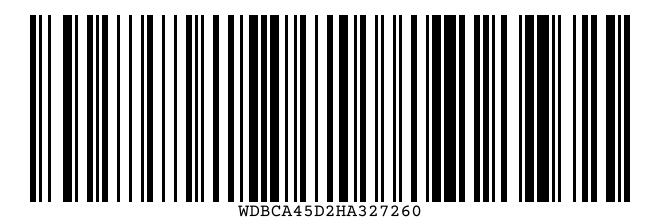
I haven’t mentioned PDF417 yet, and that’s because I think the only good reason to use them in 2026 is if you have to. They take up a lot of physical space and in my experience, scanners struggle with larger PDF417 symbols too. They made sense in a world of linear scanners, which have largely died out as other 2D barcodes and on-screen scanning has been popularised. I do still come across them – Eurostar boarding passes spring to mind.
There are other kinds of 2D barcodes – but they’re even more niche and if you needed to use them, you’d already know about them.
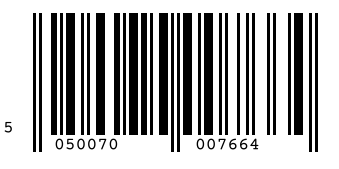
Should you use a 1D barcode? Again, if you needed to, you’d already know. Chances are it would be an EAN-13 if it’s a consumer product, or an ITF-14 on the shipping carton it travels in. Code 128 remains popular in industrial settings. But if you have a choice, go 2D instead.
PDF417 |
Code 128 |
EAN-13 |
|---|---|---|
|
|
|
See also
Printing barcodes once you’ve chosen – how to size a symbol so it scans reliably.